Istanbul Konak was easy to find once I walked down the stairs from ground level. The blue and white İznik-tiled wall at the end of the passage hinted at the exotic experience awaiting. On turning the corner from the entrance, I felt I was back in Cappadocia, in one of the underground catacombs. Once inside, I enjoyed spotting the different parts of Turkey represented in the decor: traditional Turkey (kilim, cushions and a low table), rural Turkey (stone wall), modern Turkey accented with various (non-Turkish) paintings, and mosques (arches and cupola dome). Istanbul Konak was established in 1999 as a small restaurant at a time when Kansai had few Turkish restaurants and was expanded in 2003.
As an aperitif before a Turkish meal, I always enjoy rakı, which Japanese often say tastes like medicine or toothpaste. This anis-flavoured spirit fascinates people by clouding when mixed with water. The opaqueness shows how pure the rakı is; the less opaque, more water used in the distilling process. Wanting more Japanese to enjoy rakı, owner/chef Riza Alkoc concocted a cocktail he named after the Mediterranean, Akdeniz, because its colour reminded him of the colours of the sea, especially when held up to the light. Akdeniz has a light, and slightly sweet and sour taste that prepares your taste buds for the awaiting feast.
A visit to a Turkish restaurant starts with the standard fare: cacık (yoghurt, cucumber and garlic dip), humus, baba ghanouj (eggplant dip), kebab and kofte meatballs. But trying the interesting dishes Alkoc offers give you a new perspective on Turkish cuisine. One surprise was the ravioli-like manti, which are stuffed with seasoned ground meat and topped with a garlic-yogurt sauce. Another was İstim Kebabı—eggplant wrapped around savory spiced meat and vegetables. Alkoc also recommends the Haydari yoghurt dip with garlic, and stuffed blue mussels. Not listed on the menu, which has English explanations, are the Specials of the Day: dolma (various stuffed vegetables), stews or casseroles that are guaranteed to warm you on a chilly day.
Turkish cuisine essentially uses salt as the main seasoning, and spices enhance the aroma. Despite certain ingredients being difficulty to obtain in Japan, Alkoc—who also runs the family restaurant business in Istanbul—and his Turkish cooks make every effort to serve authentic dishes by importing these ingredients direct from Turkey. He also grows spring onions, mint, parsley and other herbs for use in his dishes, because he finds the flavour is lacking when using commercially grown produce.
For dessert, I ordered mildly-sweet Kazandibi milk pudding, made with shredded chicken, and a Turkish coffee; the perfect end to a delicious meal that took me back to Turkey. Before you leave home, don’t forget to print the coupons available on the Japanese and English web pages. If you dine at Istanbul Konak on Friday and Saturday night, your experience will be enhanced by the oriental dance show featuring Tania Luiz.
And, for those who cannot come to Osaka to enjoy an evening in Turkey, Istanbul Konak delivers their dishes anywhere in Japan via their online delicatessen, Konak Deli 1. (All major credit cards accepted. Orders over 5,000 yen are delivered free.) Currently, the deli offers a taster special (e.g., chicken kebab, the chickpea stew, prawn and vegetable casserole, the chicken and vegetable casserole, and manti) with soup and rice or Turkish bread for 1,600-1,850 yen (free delivery). Also on special is a party set of nine dishes (3-4 people) for 3,980 yen with free delivery.
Istanbul Konak
Address: B1F, Sankyo Yotsubashi Bldg. 1-11-1 Minami Horie, Nishi-ku, Osaka 550-0015
Access: Subway Yotsubashi Stn Exit #5
Lunch: Mon.-Fri. 11:30-15:00; Sat., Sun., Pub. Hol. 12:00-15:00
Dinner: 17:30-22:30
Phone: 06-6534-7277
E-mail: merhaba@istanbulkonak.com
URL: http://www.istanbulkonak.com (Japanese & English)
Konak Deli I (Japanese only)
URL: http://www.istanbulkonak-deli1.com/
E-mail: shopmaster@istanbulkonak-deli1.com
Text: George Bourdaniotis. Originally published in Kansai Scene #128, January 2011.
Showing posts with label Osaka. Show all posts
Showing posts with label Osaka. Show all posts
Wednesday, 2 July 2014


Friday, 23 March 2012
Food Fit for a Thai King
Chedi Luang, Umeda and Kitahorie, Osaka
When Chedi Luang opened, 10 years ago, Thai restaurants in Osaka only served Bangkok-style food. “We filled that gap,” said supervisor, Chieko Suzumoto. “Bangkok cuisine is food-stall based, whereas Chiang Mai cuisine is the royal, restaurant-style Khantoke. Neighbouring countries – Laos, Myanmar and China – have an interesting influence on the regional cuisine.” Chiang Mai, located 700 km north of Bangkok, was the capital of the Lanna Thai kingdom in the 14th century and is the cultural centre of Thailand, like Kyoto is to Japan. Elaborate, Lanna Thai-traditional Khantoke meals are served to guests at ceremonies and celebrations on khantoke pedestal trays used as tables, similar in style to Japan’s traditional kaiseki cuisine.
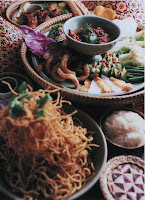
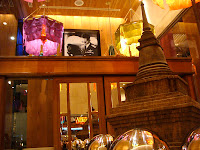
Opened in March 2011, the furniture and the gold interior at the Herbis ENT branch makes you feel royal. The tableware and the objects incorporate designs and patterns for which Chiang Mai is famous. The view of the Umeda Sky Building at night adds to the feeling of occasion, ideal for special occasions, dates or if you want to splurge. Both branches offer a 90-minute lunch buffet serving 15 dishes on weekdays and 20 on weekends and public holidays. They also offer a one-hour all-you-can-drink Heineken Extra Cold beer option for an extra 998 yen. The chefs can adjust the dishes spiciness and to accommodate pescatarians.
Chedi LuangText: George Bourdaniotis, Photos: Courtesy of Chedi Luang. Originally published in Kansai Scene #141, February 2012.
(English menu and English-speaking staff)
Herbis ENT Branch
Address: Herbis ENT 5F, 2-2-22 Umeda, Kita-ku, Osaka
Access: Umeda Stns (JR, Hankyu, Hanshin, Subway)
Weekdays: 11:30–15.00 (lunch, last order 14:30), 17:30–23:00 (dinner, last order 22.30)
Weekends, Public Holidays: 11:30–16.00 (lunch, last order 15:30), 17:00–23:00 (dinner, last order 22.30)
Closed: when Herbis ENT is closed.
Reservations: 06-6344-6116
Kitahorie Main Branch
Address: 1-17-11 Kitahorie, Nishi-ku, Osaka
Access: Subway Nishi-ohashi Stn 1 minute walk, Subway Yotsubashi Stn 4 minute walk
Weekdays: 12:00–15.00 (lunch, last order 14:30), 17:30–23:00 (dinner, last order 22.30)
Weekends, Public Holidays: 12:00–16.00 (lunch, last order 15:30), 17:00–23:00 (dinner, last order 22.30)
Closed: Monday lunch (open when Monday is a public holiday)
Reservations: 06-6535-1515
Monday, 12 March 2012
Counting My Blessings - 常に感謝を心に

I attend many professional and business networking events. Over time, I make new friends and business partners, and my network grows. When we meet, neither of us knows what the future holds. Meeting Daisuke at goodspeed was no different. We have worked on some interesting projects together since we met, so when I was contacted to be fixer for the CNN travel program, CNNGo, I did not hesitate to bring Daisuke on board. In the very brief time leading up to the shoot, we searched for guests to appear on the show, slapped together a filming schedule, went location scouting,... Thanks to everyone's cooperation, we got the job done. I always count my blessings, but this time I cannot express how grateful I am for everyone's support. Thank you! I hope readers catch the finished product on CNN, this month.
The Japanese version first appeared in the March 2012 issue of the goodspeed monthly newsletter. 日本語バージョンはグッドスピードレター2012年3月号に掲載されました。 CNN International will first air CNNGo Rebuilding Japan! Rediscovering the Beauty of Japan (Kyoto/Osaka) on March 14 and repeat it in the following weeks. After its premiere, it will be available for viewing on the CNNGo web site. 本番組は3月14日から放送されます。その後、CNNGoホームページでご覧ください。
Friday, 2 March 2012
Leading Kansai Development for 102 years

Established in 1907 by
Kobayashi Ichizo, Mino-o Arima Electric Tramway actually began operations with
two lines—the Takarazuka and Mino-o lines—on March 10, 1910. In 1918, the
company was renamed Hanshin Kyuko Railway, from which the current name Hankyu
was derived in 1973. The Kobe Line, which opened in 1920 and was extended to
Sannomiya in 1936, was a direct rival to Hanshin Railway, which also operated
between Osaka and Kobe. The rivalry continued until Hankyu acquired Hanshin in
October 2006 to create Hankyu Hanshin Holdings, Inc.
Hankyu briefly merged with
Keihan Electric Railway, another private railway in 1943. When Keihan spilt
away in 1949, Hankyu retained what today are the Kyoto, the Senri and the
Arashiyama lines. It was the first railway company in Japan to install
automatic ticket machines at Kita-senri Station in 1967.
To ensure the company’s prosperity, Kobayashi developed the
real estate along its lines. In particular, he established the Takarazuka Revue
and the Takarazuka Family Land amusement park, which closed in 2003, to draw
passengers for the Takarazuka Line. Today, the real estate along most of the
Hankyu lines has a prestigious image, with the real estate north of the Kobe
Line between Nishinomiya-Kitaguchi and Rokko Stations being one of the most
expensive areas in the Kansai.
Text and photos by George Bourdaniotis. Originally published in Kansai Scene #120, May 2010 as "Leading Kansai development for 100 years".
Monday, 15 March 2010
Wood Block Prints & Antique Books
Until a year ago, there was a two-storey secondhand bookshop in the Center-Gai shopping arcade in Sannomiya that carried a large range of ukiyoe (wood block prints) at various prices and in various conditions. I went there often to buy presents for people’s birthdays and used to enjoy poring through the ukiyoe looking for just the right one. They make ideal gifts, because are light to carry overseas—though you do need to be careful not to crush them. (Go to a 100-yen shop and buy a tube.) Since then I have searched in vain for other shops that carry old ukiyoe in Sannomiya, but to no avail. The area behind Daiei supermarket—to the west of JR Sannomiya Stn—used to have many secondhand bookshops hidden in the warren of streets, but the earthquake put most of them out of business and those that survived eventually closed down.

If you are visiting Kobe, then you will probably be passing through Osaka, or even sightseeing there. Inevitably, you will pass through the Umeda area—JR Osaka Stn, Hankyu Umeda Stn, Hanshin Umeda Stn, and Subway Umeda, Higashi-umeda and Nishi-umeda Stns. Here, you will find a few shops that will save your feet.


Once you get to Umeda, ask people where Kiddyland is. If you find someone who does not know, then they are from out of town. Once you get to Kiddyland (which is below ground), keep heading above ground under the Hankyu train tracks. Another landmark to watch out for is D•D House. If you find that, then Kappa Yokocho is directly opposite under the train tracks.
Business Hours:
11 a.m. ~ 8 p.m. (The restaurants are open until 11 p.m.)
Closed: 3rd Wednesday in February, April, June, September and November.
* You will see a green frog-like creature in the entrance. This is the legendary Japanese creature, the kappa.
Subscribe to:
Posts (Atom)