Istanbul Konak was easy to find once I walked down the stairs from ground level. The blue and white İznik-tiled wall at the end of the passage hinted at the exotic experience awaiting. On turning the corner from the entrance, I felt I was back in Cappadocia, in one of the underground catacombs. Once inside, I enjoyed spotting the different parts of Turkey represented in the decor: traditional Turkey (kilim, cushions and a low table), rural Turkey (stone wall), modern Turkey accented with various (non-Turkish) paintings, and mosques (arches and cupola dome). Istanbul Konak was established in 1999 as a small restaurant at a time when Kansai had few Turkish restaurants and was expanded in 2003.
As an aperitif before a Turkish meal, I always enjoy rakı, which Japanese often say tastes like medicine or toothpaste. This anis-flavoured spirit fascinates people by clouding when mixed with water. The opaqueness shows how pure the rakı is; the less opaque, more water used in the distilling process. Wanting more Japanese to enjoy rakı, owner/chef Riza Alkoc concocted a cocktail he named after the Mediterranean, Akdeniz, because its colour reminded him of the colours of the sea, especially when held up to the light. Akdeniz has a light, and slightly sweet and sour taste that prepares your taste buds for the awaiting feast.
A visit to a Turkish restaurant starts with the standard fare: cacık (yoghurt, cucumber and garlic dip), humus, baba ghanouj (eggplant dip), kebab and kofte meatballs. But trying the interesting dishes Alkoc offers give you a new perspective on Turkish cuisine. One surprise was the ravioli-like manti, which are stuffed with seasoned ground meat and topped with a garlic-yogurt sauce. Another was İstim Kebabı—eggplant wrapped around savory spiced meat and vegetables. Alkoc also recommends the Haydari yoghurt dip with garlic, and stuffed blue mussels. Not listed on the menu, which has English explanations, are the Specials of the Day: dolma (various stuffed vegetables), stews or casseroles that are guaranteed to warm you on a chilly day.
Turkish cuisine essentially uses salt as the main seasoning, and spices enhance the aroma. Despite certain ingredients being difficulty to obtain in Japan, Alkoc—who also runs the family restaurant business in Istanbul—and his Turkish cooks make every effort to serve authentic dishes by importing these ingredients direct from Turkey. He also grows spring onions, mint, parsley and other herbs for use in his dishes, because he finds the flavour is lacking when using commercially grown produce.
For dessert, I ordered mildly-sweet Kazandibi milk pudding, made with shredded chicken, and a Turkish coffee; the perfect end to a delicious meal that took me back to Turkey. Before you leave home, don’t forget to print the coupons available on the Japanese and English web pages. If you dine at Istanbul Konak on Friday and Saturday night, your experience will be enhanced by the oriental dance show featuring Tania Luiz.
And, for those who cannot come to Osaka to enjoy an evening in Turkey, Istanbul Konak delivers their dishes anywhere in Japan via their online delicatessen, Konak Deli 1. (All major credit cards accepted. Orders over 5,000 yen are delivered free.) Currently, the deli offers a taster special (e.g., chicken kebab, the chickpea stew, prawn and vegetable casserole, the chicken and vegetable casserole, and manti) with soup and rice or Turkish bread for 1,600-1,850 yen (free delivery). Also on special is a party set of nine dishes (3-4 people) for 3,980 yen with free delivery.
Istanbul Konak
Address: B1F, Sankyo Yotsubashi Bldg. 1-11-1 Minami Horie, Nishi-ku, Osaka 550-0015
Access: Subway Yotsubashi Stn Exit #5
Lunch: Mon.-Fri. 11:30-15:00; Sat., Sun., Pub. Hol. 12:00-15:00
Dinner: 17:30-22:30
Phone: 06-6534-7277
E-mail: merhaba@istanbulkonak.com
URL: http://www.istanbulkonak.com (Japanese & English)
Konak Deli I (Japanese only)
URL: http://www.istanbulkonak-deli1.com/
E-mail: shopmaster@istanbulkonak-deli1.com
Text: George Bourdaniotis. Originally published in Kansai Scene #128, January 2011.
Showing posts with label food. Show all posts
Showing posts with label food. Show all posts
Wednesday, 2 July 2014


Thursday, 3 April 2014
Machiya Dining Guide to Kyoto

Every resident of Kansai at least - and anyone visiting Kyoto, for that fact - should buy this and Clancy's Exploring Kyoto. Both are indispensable guides that work well together. Having done a lot of work dealing with Kyoto recently, I appreciate Clancy's work and grasp of Kyoto, its culture and its history even more. If you want to do your friends and family a favour, buy them Kyoto the City of Zen.
Definitely the restaurant guide and the on-foot guide to Kyoto are a must, whether you live in Japan or are just travelling through. Both highly recommended.
Judith will be talking at a machiya restaurant for the Society of Writers, Editors, and Translators (SWET) on May 11, 2014, in Kyoto. Check the web site for more details.
Read an article on the SWET web site about the evolution of the restaurant guide.
Buy the paperback or the Kindle versions here:
Kyoto Machiya Restaurant Guide: Amazon JP, Amazon US
Exploring Kyoto: Amazon JP, Amazon US
Kyoto the City of Zen: Amazon JP, Amazon US
Wednesday, 22 January 2014
Murakami: City of Salmon and Sake / 恵みの川・伝統の鮭料理を味わう~新潟
Food is a national pastime in Japan and for good reason. No matter where you go,
each village, city, or region will have local cuisine made with local produce,
so traveling in Japan is fun. As a translator I often get jobs where I must
describe food in subtle detail, so you can call me a desktop traveller. I often
wonder if my clients would pay me to sample the fare. So I did not hesitate when
I was asked by NHK World to go to Murakami for their program, Journeys in Japan, to taste the local salmon cuisine and sake. The variety of
salmon cookery was amazing.
旅をする時、日本人にとって食事が大事です。地元の味や珍味を堪能したいのです。自分でも日本のあっちこっちに旅する程、大事にしていることがよく分かります。どの地方へ行っても美味しい物が待っています。普段仕事している中、料理の説明等を英訳する仕事もあります。細かい味まで英語で表現をしないとだめですが、食べたことがないのにどう上手く表現するか毎回悩まされます。先方に頼みましたら、行かせていただくかなとよく思います。しかし実際は無理です。だからこそ、今回NHK国際放送のディレクターから新潟県の村上市に行かない?との誘いを聞いた時、思わず「行く」と即答しました。村上市と言えば、鮭。村上市は鮭の一人あたり消費量が日本トップクラスだそうです。「塩引き鮭」や「酒浸し」など実に100種類の鮭料理があることは自慢です。尾以外全部料理に使うのがびっくりしました。老舗料亭から地元民の通う総菜店まで、まさに鮭三昧で堪能できました。
The Murakami episode of Journeys in Japan will be broadcast on NHK World on January 28, 2014, UTC.
本番組「恵みの川・伝統の鮭料理を味わう~新潟」は2014年1月30日午前3時にNHK BS1にて放送されます。
 |
| (back) Deep-fried gills, stewed brow, smoked soft roe (centre) Deep-fried skin, stewed flesh, clear broth with roe skin (front) Stewed backbone, roe marinated in soy sauce |
The Murakami episode of Journeys in Japan will be broadcast on NHK World on January 28, 2014, UTC.
本番組「恵みの川・伝統の鮭料理を味わう~新潟」は2014年1月30日午前3時にNHK BS1にて放送されます。
Monday, 23 April 2012
Lordly Indian
The aroma of simmering curry is inviting, and I find resistance futile, even on a blistering hot day. After ordering a lunch set at Gaylord Tarumi, I ordered a Cobra beer — brewed in the UK and exclusively distributed in Japan by Gaylord — to soothe my taste buds while eating the channa curry. Especially brewed for imbibing with spicy Indian cuisine, this beer is smooth and has little gas. The light, refreshing taste is popular in Japan with women, but it doesn’t hit the spot for some men. My lunch set came with two flavours of succulent chicken tikka — my mark of a good Indian restaurant.
 “There are many Indian restaurants in every city across Japan, today, competing with each other. We differentiate ourselves by focusing on quality,” says Hiromi Sakata from Gaylord. “We use only fresh locally produced chicken, fruit and vegetables from Hyogo Prefecture to create the delicious curries and other dishes.” Therefore decreasing their ecological footprint. The Australian and New Zealand lamb and mutton is halal. The adventurous diner can create their own curry for ¥1,800, by choosing one of seven base sauces, including Masala (onion), Makhanwala (tomato and cream), Sagwala (spinach) and Khorma (nuts and cream), and one of the various main ingredients.
Premier, international Indian restaurant chain, Gaylord, opened its first Japan branch in 1973 to serve the local Kobe Indian community, when Kobe had no Indian restaurants. They now run two restaurants in Kobe: Sannomiya and Tarumi (Marine Pier). The sets offered at both branches differ to cater for different clientele; the Sannomiya branch has business clientele, and the Tarumi branch, shoppers and families. Visit the Tarumi branch, which has parking, at night and enjoy the spectacular view of the illuminated Akashi Ohashi bridge. If you are going to the Sannomiya branch with a group for dinner, Sakata-san recommends you book, because it is smaller than the Tarumi branch.

Though not included in the lunch set, I decided to have the creamy, rich saffron and pistachio ice-cream. You can taste each ingredient. The ice cream is made from 100 per cent Jersey fullcream milk, saffron, nuts, sugar — no preservatives or additives. This autumn, Gaylord will release its ice-cream in department stores, supermarkets and their online shop. The full range offers five flavours that will not be available in their restaurants — yoghurt, ginger, soy mango, saffron, chai and pistachio — are also made using their original recipe. “The ice cream is that delicious, because your mouth is still sensitive after eating a hot curry. It will taste different again when you eat it separately.”
Gaylord Indian Restaurant
Sannomiya Branch
Address: B1F, KDC Kobe Bldg, 83 Kyo-machi, Chuo-ku, Kobe
Access: Sannomiya Stn
Open: 11:30am–3pm (lunch), 3pm–4:30pm (tea time), 5pm–9pm (dinner).
Closed: Monday
Reservations: 078-392-8200
Gaylord Port Bazaar Branch
Address: Marine Pia Kobe, 12-2, Kaigan-dori, Tarumi-ku, Kobe
Access: JR or Sanyo Tarumi Stn
Open: 11am–3pm (lunch), 3pm–5pm (tea time), 5pm–9pm (dinner)
Reservations: 078-708-4359
Readymade Curries online shop
Text & Photos: George Bourdaniotis. Originally published in Kansai Scene #136, September 2011.
Premier, international Indian restaurant chain, Gaylord, opened its first Japan branch in 1973 to serve the local Kobe Indian community, when Kobe had no Indian restaurants. They now run two restaurants in Kobe: Sannomiya and Tarumi (Marine Pier). The sets offered at both branches differ to cater for different clientele; the Sannomiya branch has business clientele, and the Tarumi branch, shoppers and families. Visit the Tarumi branch, which has parking, at night and enjoy the spectacular view of the illuminated Akashi Ohashi bridge. If you are going to the Sannomiya branch with a group for dinner, Sakata-san recommends you book, because it is smaller than the Tarumi branch.
Though not included in the lunch set, I decided to have the creamy, rich saffron and pistachio ice-cream. You can taste each ingredient. The ice cream is made from 100 per cent Jersey fullcream milk, saffron, nuts, sugar — no preservatives or additives. This autumn, Gaylord will release its ice-cream in department stores, supermarkets and their online shop. The full range offers five flavours that will not be available in their restaurants — yoghurt, ginger, soy mango, saffron, chai and pistachio — are also made using their original recipe. “The ice cream is that delicious, because your mouth is still sensitive after eating a hot curry. It will taste different again when you eat it separately.”
Gaylord Indian Restaurant
Sannomiya Branch
Address: B1F, KDC Kobe Bldg, 83 Kyo-machi, Chuo-ku, Kobe
Access: Sannomiya Stn
Open: 11:30am–3pm (lunch), 3pm–4:30pm (tea time), 5pm–9pm (dinner).
Closed: Monday
Reservations: 078-392-8200
Gaylord Port Bazaar Branch
Address: Marine Pia Kobe, 12-2, Kaigan-dori, Tarumi-ku, Kobe
Access: JR or Sanyo Tarumi Stn
Open: 11am–3pm (lunch), 3pm–5pm (tea time), 5pm–9pm (dinner)
Reservations: 078-708-4359
Readymade Curries online shop
Text & Photos: George Bourdaniotis. Originally published in Kansai Scene #136, September 2011.
Friday, 23 March 2012
Food Fit for a Thai King
Chedi Luang, Umeda and Kitahorie, Osaka
When Chedi Luang opened, 10 years ago, Thai restaurants in Osaka only served Bangkok-style food. “We filled that gap,” said supervisor, Chieko Suzumoto. “Bangkok cuisine is food-stall based, whereas Chiang Mai cuisine is the royal, restaurant-style Khantoke. Neighbouring countries – Laos, Myanmar and China – have an interesting influence on the regional cuisine.” Chiang Mai, located 700 km north of Bangkok, was the capital of the Lanna Thai kingdom in the 14th century and is the cultural centre of Thailand, like Kyoto is to Japan. Elaborate, Lanna Thai-traditional Khantoke meals are served to guests at ceremonies and celebrations on khantoke pedestal trays used as tables, similar in style to Japan’s traditional kaiseki cuisine.
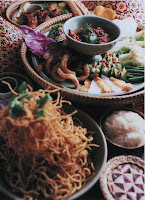
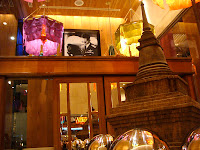
Opened in March 2011, the furniture and the gold interior at the Herbis ENT branch makes you feel royal. The tableware and the objects incorporate designs and patterns for which Chiang Mai is famous. The view of the Umeda Sky Building at night adds to the feeling of occasion, ideal for special occasions, dates or if you want to splurge. Both branches offer a 90-minute lunch buffet serving 15 dishes on weekdays and 20 on weekends and public holidays. They also offer a one-hour all-you-can-drink Heineken Extra Cold beer option for an extra 998 yen. The chefs can adjust the dishes spiciness and to accommodate pescatarians.
Chedi LuangText: George Bourdaniotis, Photos: Courtesy of Chedi Luang. Originally published in Kansai Scene #141, February 2012.
(English menu and English-speaking staff)
Herbis ENT Branch
Address: Herbis ENT 5F, 2-2-22 Umeda, Kita-ku, Osaka
Access: Umeda Stns (JR, Hankyu, Hanshin, Subway)
Weekdays: 11:30–15.00 (lunch, last order 14:30), 17:30–23:00 (dinner, last order 22.30)
Weekends, Public Holidays: 11:30–16.00 (lunch, last order 15:30), 17:00–23:00 (dinner, last order 22.30)
Closed: when Herbis ENT is closed.
Reservations: 06-6344-6116
Kitahorie Main Branch
Address: 1-17-11 Kitahorie, Nishi-ku, Osaka
Access: Subway Nishi-ohashi Stn 1 minute walk, Subway Yotsubashi Stn 4 minute walk
Weekdays: 12:00–15.00 (lunch, last order 14:30), 17:30–23:00 (dinner, last order 22.30)
Weekends, Public Holidays: 12:00–16.00 (lunch, last order 15:30), 17:00–23:00 (dinner, last order 22.30)
Closed: Monday lunch (open when Monday is a public holiday)
Reservations: 06-6535-1515
Saturday, 20 February 2010
Grinders for Burgers


Located one block east of Sogo Department Store, opposite Beams, this little burger joint is one of Kobe’s best kept secrets. The owner, who speaks excellent English, wanted to open a hamburger joint in Japan and travelled the U.S. looking for the right hamburger. He finally approached Grinders burgers to allow him to open a franchise in Kobe.

My friend ordered a large Basil and Avocado Burger and she was afraid that she would not get through it; it was so big. She did, however, because “it tasted so good”. Other burgers include Super Cheese with a cream cheese and oregano sauce, Italiano Verde with a basil and parsley sauce, Hot Salsa, and Japanese-style with lots of mushrooms. The burgers are made with 100% quality Australian beef and fresh vegetables, and made fresh to order. The prices might seem more expensive than you are used to paying, but you will not be disappointed.
Of course, there are sets, freshly made soups, and other items on the menu to tempt you. As well as your standard soft drinks, Grinders also stocks a wide range of imported beers at reasonable prices; Samuel Adams, VB, Negro Modelo, Singha, Fosters and more.
Business hours:
11:00-20:00 (11:00-15:00 Tuesdays)
Closed Mondays & the 1st and 3rd Tuesdays of the month.
Address:
B1F Maki Bldg, 7-1-5 Onoedori, Chuo-ku, Kobe
Phone: 078-267-3350
Subscribe to:
Posts (Atom)